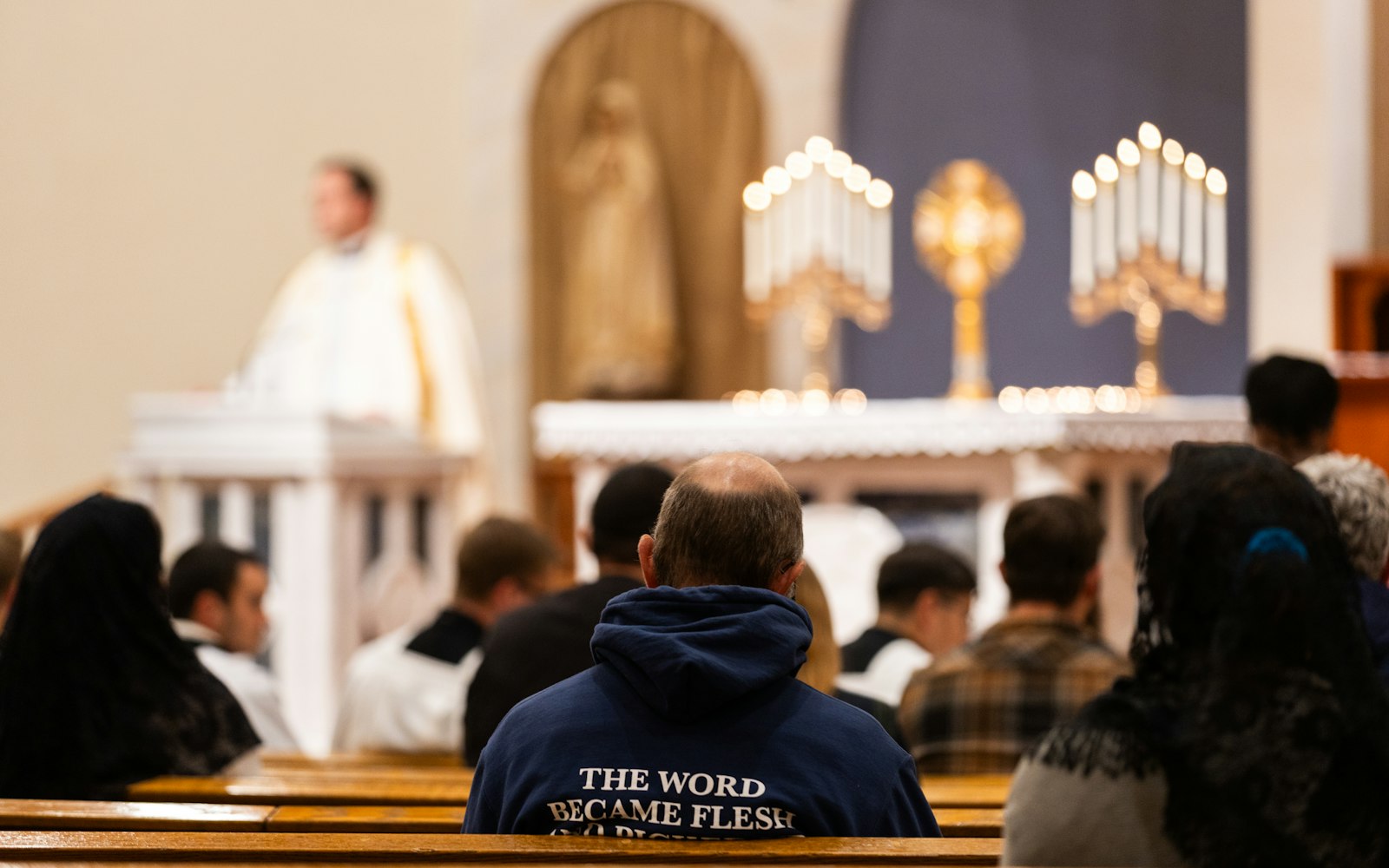
The first thing I noticed was how everyone already knew what to do.
Not just the choreography — when to stand, when to kneel, when to say the responses. It was something underneath that. They were performing reverence and meaning it at the same time. Like watching my grand aunt pray to Chinese deities when I was a kid. She wasn't reciting. She was somewhere else entirely. These people had that. I didn't. I'm Taiwanese American, from a family where going to church was not something anyone did. Walking into that building, I could feel the gap between them and me — not about the room, but about the fact that they'd already decided something I hadn't.
I went to church for years before I converted. In college I'd been exposed to Christianity — not Catholic, the kind with a full band and someone asking you to raise your hand if you accepted Jesus as your savior. There's something that happens in a room like that. The music is designed to drop your guard. A hundred people with their eyes closed and their hands up, and part of you just wants to let go — drop the fight, stop holding the line. Like a man who's been arguing for hours and starts to wonder why he's still fighting. I put my hand up. I wasn't sure if God was real, but I was sure it helped me belong.
The hard part walking into this parish was different. Just silence, and ritual, and my wife next to me who already knew exactly where she was.
I knelt with them. I did everything. I stood when they stood, said the responses, did the whole thing. I don't know when it stopped being for her and started being a habit. Somewhere along the way the questions just... froze. I wasn't convinced. I wasn't not convinced. I was truly agnostic — in the original sense, I just didn't know. And I kept showing up anyway.
If you're in the pew right now because someone you love is there, I wrote this for you.
The intellectual door
The intellectual door opened at work. I was at a mental health startup with a psychiatrist. One afternoon the question came up: do apes have morals? Where did morality come from? Even the most secular person in the room got quiet. The fact that the question was genuinely open — that there was a frontier here — cracked something in me.
Then apologetics. William Lane Craig. The Kalam Cosmological Argument: everything that begins to exist has a cause. The universe began to exist. Therefore the universe has a cause. The logic sat with me. I bought a book from a church bookstore in San Jose — the cosmological argument, the existence of God — and left it on the nightstand. I knew in the back of my mind how it looked. But hey. I was trying.
But it wasn't the books. It was the smart people I knew around me. When the person across the table from you, the one you respect intellectually, tells you they believe, it lands differently than any argument. That's more visceral. Far more convincing.
I found the intellectual framework alone, late, on the internet. The way engineers find things. But I didn't find the Church that way. I found it through my wife. Years in the pews before any of it landed. And in 2018, a medical emergency that changed the question from academic to personal. The short version: I know what it's like to stop fighting and hand it over. You don't choose it. You just run out. (That night is in Times New Roman.)
The Zoom RCIA
My RCIA was on Zoom — one of those unfortunate accidents of the pandemic, when even something as intimate as this had to happen through camera squares and muted microphones and someone sharing their screen to show the Nicene Creed. Through no one's fault, it could feel like a business meeting.
I remember one session, we went around and said how we were doing on a scale of 1 to 10. I said 6 out of 10 — not bad, but I'm still lonely. The room went quiet.
I was in full engineer mode — if the premise is true, follow it all the way down. I wanted to answer everything truthfully, ask the hard question, poke at the whole thing. What I forgot was that I was in a room full of people doing something vulnerable. I was good at asking good questions. Not kind ones. The instinct to audit is real, and it isn't wrong — but there's a version of it that keeps you at arm's length from the very thing you came to examine. It took me a long time to see that in myself.
What got through, even on Zoom, was the director talking about the visceral part. The smell of incense. The vestments. The weight of a building that has held the same rituals for centuries. He had something to say, and when he spoke up, you could feel the room shift even through a laptop speaker. I felt it on those calls, even through bad Wi-Fi — that pull toward something I couldn't yet name.
The confession I skipped
Confession was supposed to happen at St. Damiano in Danville during a retreat. I skipped it. Told them I wasn't ready. And I actually really wasn't ready. That part was true.
My psychiatrist, around this same time, said something that stuck. I told him I couldn't feel much — not the crying, not the feeling moved that's such a big part of worship for a lot of people. He said there's a rational way to God. He had his own faith and wasn't afraid to talk about it. So I asked genuinely, and he opened up. He had a lot to say. That mattered to me: I didn't have to fake an emotional response I hadn't had yet. There was a door I could actually walk through.
When I finally went to confession, I sat down and started talking. Like I was coming clean — a memoir out loud. But something happened before I even got in. You sit in line with a sheet. You reflect. The exam of conscience. The longer I sat with it, the closer I felt to God. Not asking a therapist for normalization. Not running a blame game. Just what was in my heart.
I was drawn really close to God. I don't know how else to say it.
It surprised me, because it wasn't what confession looks like from the pew. I'd carried something a long time without saying it out loud, and the thing turned out to be built for exactly that.
What I'd say to myself in that pew
I didn't come back to a faith I had drifted from. I was a convert whose path in ran through a medical crisis that changed the question from academic to personal. My path in was not clean or linear. It was an argument about apes. It was a Zoom call the pandemic forced onto a laptop screen. It was a psychiatrist who had his own faith and wasn't afraid to talk about it. But the longer I stayed with it, the more I figured out how to be in that room — how to ask without treating it like a code review, how to be a respectful human in a space that deserved that.
If I could go back to the version of me sitting in that pew, hyperaware of the demographics and the social dynamics, running the mental calculations, here's what I'd tell him:
Look. I know you've got a bunch of questions. But quit auditing the room. Just pay attention and live in this culture. The answer will come to you. You know that is true in your heart. So stop getting in your own way.
I can't tell you the answer came. I can tell you I stopped fighting the question. And the pew got more comfortable after that. Not because anything changed about the room. Same parish. Same liturgy. Same Sunday. But I was kneeling for real.