Today · Wednesday, July 22
Next Mass
Today's Readings6:45AM
Mass
Today
Today
8:30 AM
Why does another Mass times site exist? Read my story →
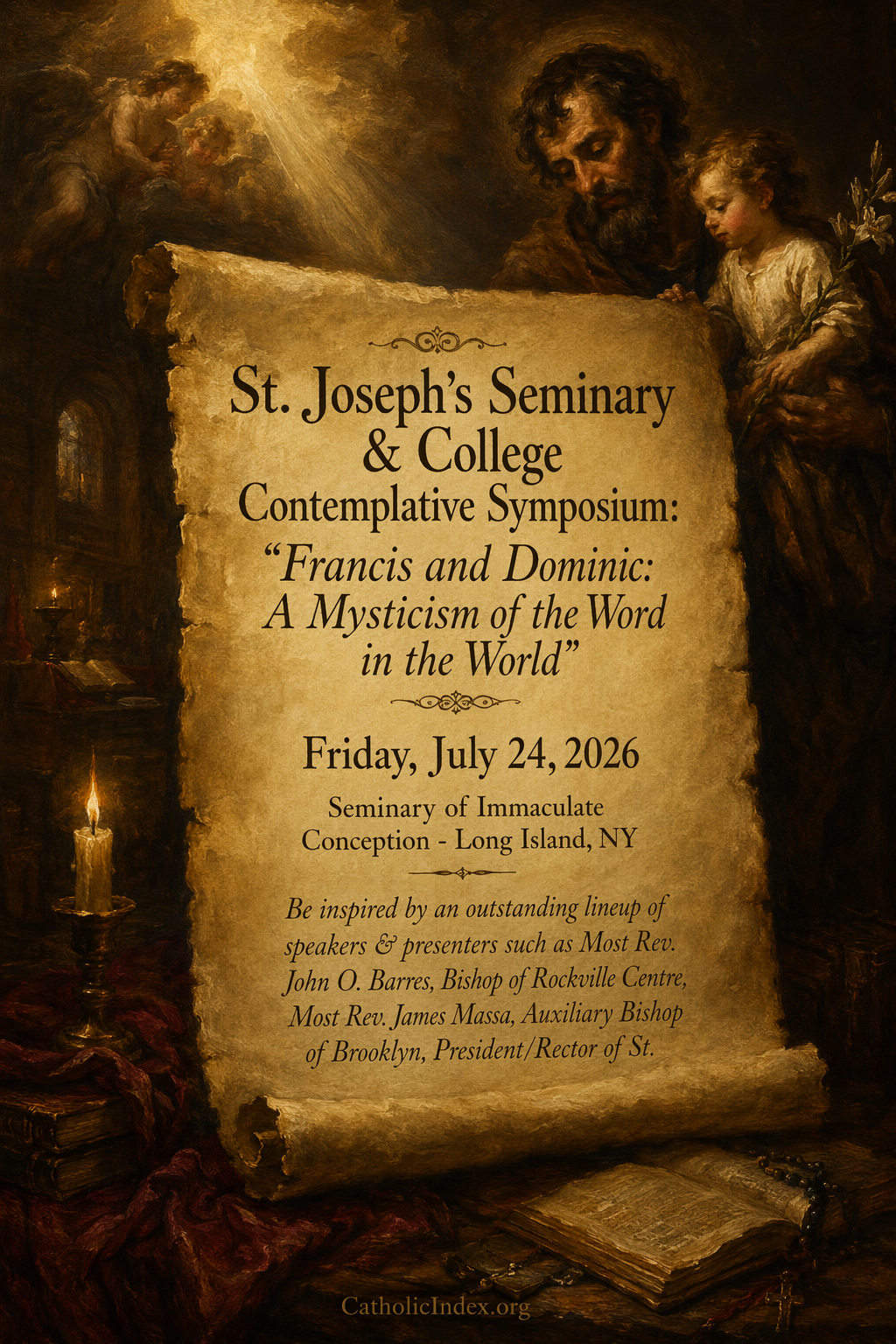
Be inspired by an outstanding lineup of speakers & presenters such as Most Rev. John O. Barres, Bishop of Rockville Centre, Most Rev. James Massa, Auxiliary Bishop of Brooklyn, President/Rector of St. Joseph's Seminary & more!
Before continuing with the Introductory Rites of the Mass from where we left off last week, I want to communicate one more teaching about the importance of music and song during the Mass. As I wrote last week, the song that accompanies the Entrance Procession serves to unify the people at Mass. Thus, singing is an integral part of the Mass and expresses not only our unity but our faith. As the General Instruction of the Roman Missal states, "The Christian faithful who gather together as one to await the Lord's coming are instructed by the Apostle Paul to sing together psalms, hymns, and spiritual songs (cf. Col 3:16). Singing is the sign of the heart's joy (cf. Acts 2:46). Thus St. Augustine says rightly, 'Singing is for one who loves.'" (GIRM, #39) I highlight this teaching to encourage all of us to grow in our quality and confidence in singing during the Holy Mass on Sunday. Continuing with the Introductory Rites, the Entrance Procession concludes as the priest and deacon reverence the altar. This is done by bowing to and kissing the altar (a gesture that may go unnoticed by many members of the congregation) as well as incensing the altar when incense is used at Mass. The act of bowing and kissing the altar is a gesture of homage and brotherly love. The altar represents Christ and so the priest as president of the congregation greets the head of the house, so to speak, who is Jesus Christ, the King and Savior. The actual "greeting" of the altar includes placing hands on the altar as it is kissed harkening back to the Eastern form of the brotherly embrace, a greeting that is still used in many families today. Next the priest presider arrives at the chair and begins the Mass with the sign of the cross and the greeting of the people. The sign of the cross is an ancient gesture that proclaims our belief in the Holy Trinity and the redemption of the world by Christ's death on the cross. Tracing the cross on the body highlights how God, Father, Son and Holy Spirit, loves the whole person and the truth that Christ has redeemed the whole person, body and soul. As we all know, this physical gesture is the common form of beginning and ending prayer and so reminds us that the Mass is a prayer, liturgical and sacramental. The greeting that the priest gives to the people and their subsequent response renews the bond of love and respect between the people and the priest. The greeting formulas are all rooted in Sacred Scripture and begin to reveal how much of the sacred writings of the Bible are contained in the words of the Mass. Two of the three options for the greeting come from the words of St. Paul (2 Cor. 13:13 and Romans 1:7) and the third option comes from the Gospel of Luke (Luke 1:28). The response of the people ("And with your spirit.") is an ancient Semitic response and is contained in a number of places in the writings of St. Paul. Next week we will continue our close look at the Introductory Rites of the Mass.
Pat Jensma* Margie Chorba* Carol McGrath* Kevin Kearney* Paula Syrko* Eamon Rodriguez Michael Quinlin Jamie O'Connell Heather Costello Alessandro Cuellar Andrew Padilla Kevin McSweeney *Names remain for 3 months unless otherwise noted.
Fathers McKeon and Baker are noted as exceptional priests, delivering excellent sermons.
Catholic Index is not affiliated with St. Catharine of Alexandria. Information is sourced from the parish website and public bulletins and may contain errors. Report a correction →
Read sacred intentions from travelers and locals, then join the virtual candle wall to add your own prayer.
0 candles burning now at Catholic Index
Be inspired by an outstanding lineup of speakers & presenters such as Most Rev. John O. Barres, Bishop of Rockville Centre, Most Rev. James Massa, Auxiliary Bishop of Brooklyn, President/Rector of St. Joseph's Seminary & more!
Before continuing with the Introductory Rites of the Mass from where we left off last week, I want to communicate one more teaching about the importance of music and song during the Mass. As I wrote last week, the song that accompanies the Entrance Procession serves to unify the people at Mass. Thus, singing is an integral part of the Mass and expresses not only our unity but our faith. As the General Instruction of the Roman Missal states, "The Christian faithful who gather together as one to await the Lord's coming are instructed by the Apostle Paul to sing together psalms, hymns, and spiritual songs (cf. Col 3:16). Singing is the sign of the heart's joy (cf. Acts 2:46). Thus St. Augustine says rightly, 'Singing is for one who loves.'" (GIRM, #39) I highlight this teaching to encourage all of us to grow in our quality and confidence in singing during the Holy Mass on Sunday. Continuing with the Introductory Rites, the Entrance Procession concludes as the priest and deacon reverence the altar. This is done by bowing to and kissing the altar (a gesture that may go unnoticed by many members of the congregation) as well as incensing the altar when incense is used at Mass. The act of bowing and kissing the altar is a gesture of homage and brotherly love. The altar represents Christ and so the priest as president of the congregation greets the head of the house, so to speak, who is Jesus Christ, the King and Savior. The actual "greeting" of the altar includes placing hands on the altar as it is kissed harkening back to the Eastern form of the brotherly embrace, a greeting that is still used in many families today. Next the priest presider arrives at the chair and begins the Mass with the sign of the cross and the greeting of the people. The sign of the cross is an ancient gesture that proclaims our belief in the Holy Trinity and the redemption of the world by Christ's death on the cross. Tracing the cross on the body highlights how God, Father, Son and Holy Spirit, loves the whole person and the truth that Christ has redeemed the whole person, body and soul. As we all know, this physical gesture is the common form of beginning and ending prayer and so reminds us that the Mass is a prayer, liturgical and sacramental. The greeting that the priest gives to the people and their subsequent response renews the bond of love and respect between the people and the priest. The greeting formulas are all rooted in Sacred Scripture and begin to reveal how much of the sacred writings of the Bible are contained in the words of the Mass. Two of the three options for the greeting come from the words of St. Paul (2 Cor. 13:13 and Romans 1:7) and the third option comes from the Gospel of Luke (Luke 1:28). The response of the people ("And with your spirit.") is an ancient Semitic response and is contained in a number of places in the writings of St. Paul. Next week we will continue our close look at the Introductory Rites of the Mass.
Pat Jensma* Margie Chorba* Carol McGrath* Kevin Kearney* Paula Syrko* Eamon Rodriguez Michael Quinlin Jamie O'Connell Heather Costello Alessandro Cuellar Andrew Padilla Kevin McSweeney *Names remain for 3 months unless otherwise noted.
Fathers McKeon and Baker are noted as exceptional priests, delivering excellent sermons.
Catholic Index is not affiliated with St. Catharine of Alexandria. Information is sourced from the parish website and public bulletins and may contain errors. Report a correction →
Read sacred intentions from travelers and locals, then join the virtual candle wall to add your own prayer.
0 candles burning now at Catholic Index