Next · Wednesday, July 22
Next Mass
Today's Readings9:00AM
Mass
Wednesday, July 22
Wednesday, July 22
7:00 PM
Why does another Mass times site exist? Read my story →
Dear Friends in Christ,
July 11th the Church celebrates the memorial of one of the greatest and most influential of all the saints: St. Benedict of Nursia, Abbot, often called the founder of Western monasticism.
St. Benedict (who had a twin sister, also a Saint, named Scholastica) was born in Nursia, Italy in the year 480 AD, to a Christian family who were members of the nobility. Because of his family's relative wealth and privilege, as a young man St. Benedict was able to receive education in Rome. But as he matured, he came to be repulsed by the dissipation and immorality of the life of his fellow students and life in Rome generally. And so, around the age of 14, he abandoned his studies and left the city to pursue a life of poverty, purity, and virtue. He traveled first to Subiaco, where he lived for some years as a hermit in a cave, developing a reputation among the locals as a man of holiness and miracles. This reputation led in time to him becoming the abbot of a nearby monastery, where he introduced reforms to the life of the order. But these monks were too like the decadent Roman students Benedict had left behind, and they did not take to the austere disciplines of their new abbot. How did the monks decide to resolve this conflict? With poison. The monks disliked Benedict's reforms so much that they literally tried to kill him by slipping him a cup of poisoned wine. But St. Benedict was miraculously preserved. When he took the poisoned wine and blessed it, the cup shattered. And so St. Benedict did not die, but, prudence in this case seeming the better part of valor, he left the monastery and returned to his cave.
Despite this seeming setback, St. Benedict's reputation for holiness continued to grow, and soon many people came to Subiaco to be near him, so many in fact that he was able to build new monasteries; twelve in all with 12 disciples in each, and St. Benedict the abbot over all. Eventually, he and some of his most faithful monks left Subiaco for Cassino, arriving there in 529 AD. It was here that St. Benedict built the first abbey of Montecassino, the great primal abbey of Western monasticism. It was here that he completed The Rule of St. Benedict, the great rule of Ora et Labora, Prayer and Work, which has been used by the Benedictines to govern their monastic communities for a full fifteen centuries now. It was here that St. Benedict died on March 21, 547, surrounded by the monks of the order he had begun. He was buried in the same grave as his sister, St. Scholastica, who died in 543. She had followed him to Monte Cassino, where she founded the first Benedictine religious community for women.
Now, having heard of the miraculous shattering of a cup of poisoned wine, you might think you had heard the most surprising bits in the life of St. Benedict. But there is one further detail of his biography that may be even more surprising for many. St. Benedict was not a priest. For all his devotion to the Lord, for all his passionate desire for heroic prayer and asceticism, for all his reputation for holiness and Godliness, and for all the fruit his life has borne through the centuries-long flowering of Benedictine monasticism, St. Benedict never received Holy Orders at all, but remained all his life a layman. A simple question with a perhaps telling answer: did you assume he was a priest? Or, put more generally, do you assume that for anyone to have a truly profound effect on the life of the Church, they must be a bishop or a priest? Of course, it is often the case that bishops and priests are uniquely well-situated to have a profound effect on the life of the Church because they share by dint of ordination in the three gifts of the Lord's priesthood to teach, sanctify, and govern. But the power of the Gospel to affect the world is not limited to those gifts, beautiful and necessary as they are. The saving power of the Gospel shines forth brighter than the sun in the soul of him who gives himself up totally, dying to self so that Christ might live through them. Anyone with a deep desire for holiness and the will to seek it can change the whole world in ways we cannot possibly foresee. In a time when holiness of life and dedication to prayer are so necessary, let's look to St. Benedict for his example of prayer and work, of communal living, charity, and forbearance, and let's thank God for the transformative power of the Gospel that is present in all the baptized.
St. Benedict, Pray for us!
Fr. Morgan
Please pray for the peaceful repose of the soul(s) of the recently deceased.
Eternal rest grant unto them, O Lord, and let perpetual light shine upon them.
Homebound:
Thomas Conn Margaret Belcher Mary Farfan Arlene Louzan Laura VanValkenburg John Schneck Mary Dussault Mary Ibbetson Joseph Cosgriff Charlie & Jane Apadula
Sick:
Carol Ring Paul J. Stankard Maria Herrera Gordon Dillard John Walters Sal Martelli Mike Tolbert Frances J. Sikora Thomas Mark Kinney Donna Peluso
Active Military:
Major Sean P. Dudley, USMC
Lt. Cmdr. Sean P. McCormick, USN
Capt. Robert F. Wilfong, III USAF
2nd Lieutenant Sean Patrick McKnight
Lieutenant Joshua C. Webster, Jr. USCG
Ensign Matthew R. Webster USCG
Joseph Petras, SSG- ARNG, MP.
Seth Petras, MMN2 USN
Nathan Petras, MMN3 USN
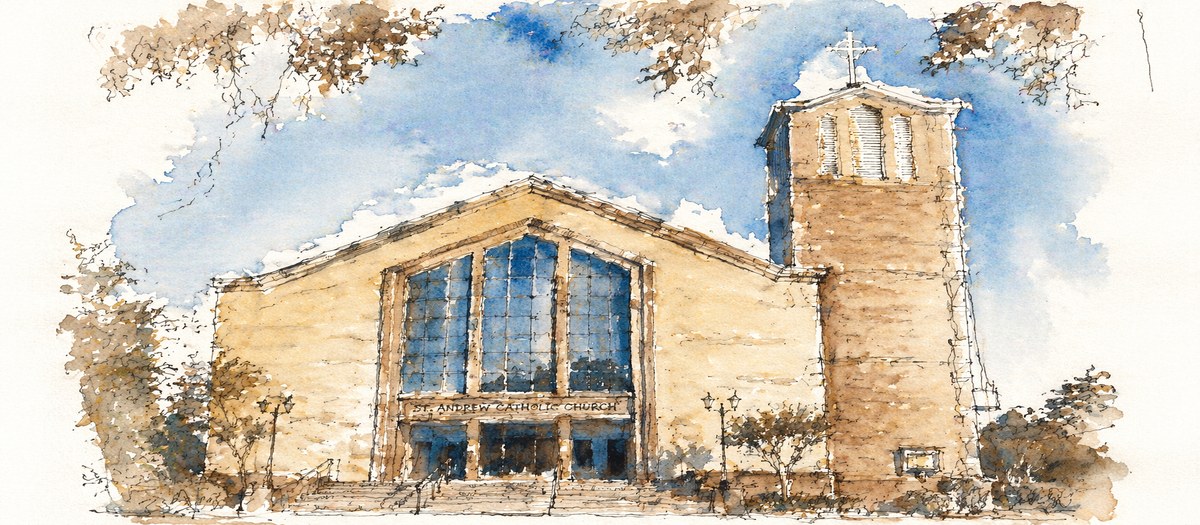
The church is beautiful and offers a true sense of reverence for Christ.
Catholic Index is not affiliated with St. Andrew. Information is sourced from the parish website and public bulletins and may contain errors. Report a correction →
Read sacred intentions from travelers and locals, then join the virtual candle wall to add your own prayer.
0 candles burning now at Catholic Index
Dear Friends in Christ,
July 11th the Church celebrates the memorial of one of the greatest and most influential of all the saints: St. Benedict of Nursia, Abbot, often called the founder of Western monasticism.
St. Benedict (who had a twin sister, also a Saint, named Scholastica) was born in Nursia, Italy in the year 480 AD, to a Christian family who were members of the nobility. Because of his family's relative wealth and privilege, as a young man St. Benedict was able to receive education in Rome. But as he matured, he came to be repulsed by the dissipation and immorality of the life of his fellow students and life in Rome generally. And so, around the age of 14, he abandoned his studies and left the city to pursue a life of poverty, purity, and virtue. He traveled first to Subiaco, where he lived for some years as a hermit in a cave, developing a reputation among the locals as a man of holiness and miracles. This reputation led in time to him becoming the abbot of a nearby monastery, where he introduced reforms to the life of the order. But these monks were too like the decadent Roman students Benedict had left behind, and they did not take to the austere disciplines of their new abbot. How did the monks decide to resolve this conflict? With poison. The monks disliked Benedict's reforms so much that they literally tried to kill him by slipping him a cup of poisoned wine. But St. Benedict was miraculously preserved. When he took the poisoned wine and blessed it, the cup shattered. And so St. Benedict did not die, but, prudence in this case seeming the better part of valor, he left the monastery and returned to his cave.
Despite this seeming setback, St. Benedict's reputation for holiness continued to grow, and soon many people came to Subiaco to be near him, so many in fact that he was able to build new monasteries; twelve in all with 12 disciples in each, and St. Benedict the abbot over all. Eventually, he and some of his most faithful monks left Subiaco for Cassino, arriving there in 529 AD. It was here that St. Benedict built the first abbey of Montecassino, the great primal abbey of Western monasticism. It was here that he completed The Rule of St. Benedict, the great rule of Ora et Labora, Prayer and Work, which has been used by the Benedictines to govern their monastic communities for a full fifteen centuries now. It was here that St. Benedict died on March 21, 547, surrounded by the monks of the order he had begun. He was buried in the same grave as his sister, St. Scholastica, who died in 543. She had followed him to Monte Cassino, where she founded the first Benedictine religious community for women.
Now, having heard of the miraculous shattering of a cup of poisoned wine, you might think you had heard the most surprising bits in the life of St. Benedict. But there is one further detail of his biography that may be even more surprising for many. St. Benedict was not a priest. For all his devotion to the Lord, for all his passionate desire for heroic prayer and asceticism, for all his reputation for holiness and Godliness, and for all the fruit his life has borne through the centuries-long flowering of Benedictine monasticism, St. Benedict never received Holy Orders at all, but remained all his life a layman. A simple question with a perhaps telling answer: did you assume he was a priest? Or, put more generally, do you assume that for anyone to have a truly profound effect on the life of the Church, they must be a bishop or a priest? Of course, it is often the case that bishops and priests are uniquely well-situated to have a profound effect on the life of the Church because they share by dint of ordination in the three gifts of the Lord's priesthood to teach, sanctify, and govern. But the power of the Gospel to affect the world is not limited to those gifts, beautiful and necessary as they are. The saving power of the Gospel shines forth brighter than the sun in the soul of him who gives himself up totally, dying to self so that Christ might live through them. Anyone with a deep desire for holiness and the will to seek it can change the whole world in ways we cannot possibly foresee. In a time when holiness of life and dedication to prayer are so necessary, let's look to St. Benedict for his example of prayer and work, of communal living, charity, and forbearance, and let's thank God for the transformative power of the Gospel that is present in all the baptized.
St. Benedict, Pray for us!
Fr. Morgan
Please pray for the peaceful repose of the soul(s) of the recently deceased.
Eternal rest grant unto them, O Lord, and let perpetual light shine upon them.
Homebound:
Thomas Conn Margaret Belcher Mary Farfan Arlene Louzan Laura VanValkenburg John Schneck Mary Dussault Mary Ibbetson Joseph Cosgriff Charlie & Jane Apadula
Sick:
Carol Ring Paul J. Stankard Maria Herrera Gordon Dillard John Walters Sal Martelli Mike Tolbert Frances J. Sikora Thomas Mark Kinney Donna Peluso
Active Military:
Major Sean P. Dudley, USMC
Lt. Cmdr. Sean P. McCormick, USN
Capt. Robert F. Wilfong, III USAF
2nd Lieutenant Sean Patrick McKnight
Lieutenant Joshua C. Webster, Jr. USCG
Ensign Matthew R. Webster USCG
Joseph Petras, SSG- ARNG, MP.
Seth Petras, MMN2 USN
Nathan Petras, MMN3 USN
The church is beautiful and offers a true sense of reverence for Christ.
Catholic Index is not affiliated with St. Andrew. Information is sourced from the parish website and public bulletins and may contain errors. Report a correction →
Read sacred intentions from travelers and locals, then join the virtual candle wall to add your own prayer.
0 candles burning now at Catholic Index